
Diyaluma Falls Upper vs Lower: Essential Guide 2026
Diyaluma Falls is often described as two waterfalls in one. It isn’t, technically. But it feels that way once it’s experienced. The lower falls are seen from the road. The upper falls are reached by a hike. Each offers something different. Neither is a wrong choice.
This guide is written to help a decision get made. Both sides are broken down. By the end, a clear answer should be found — one that fits the time available and the effort willing to be spent.
What “Upper” and “Lower” Actually Mean
Some confusion is common here, so it’s worth clearing up first.
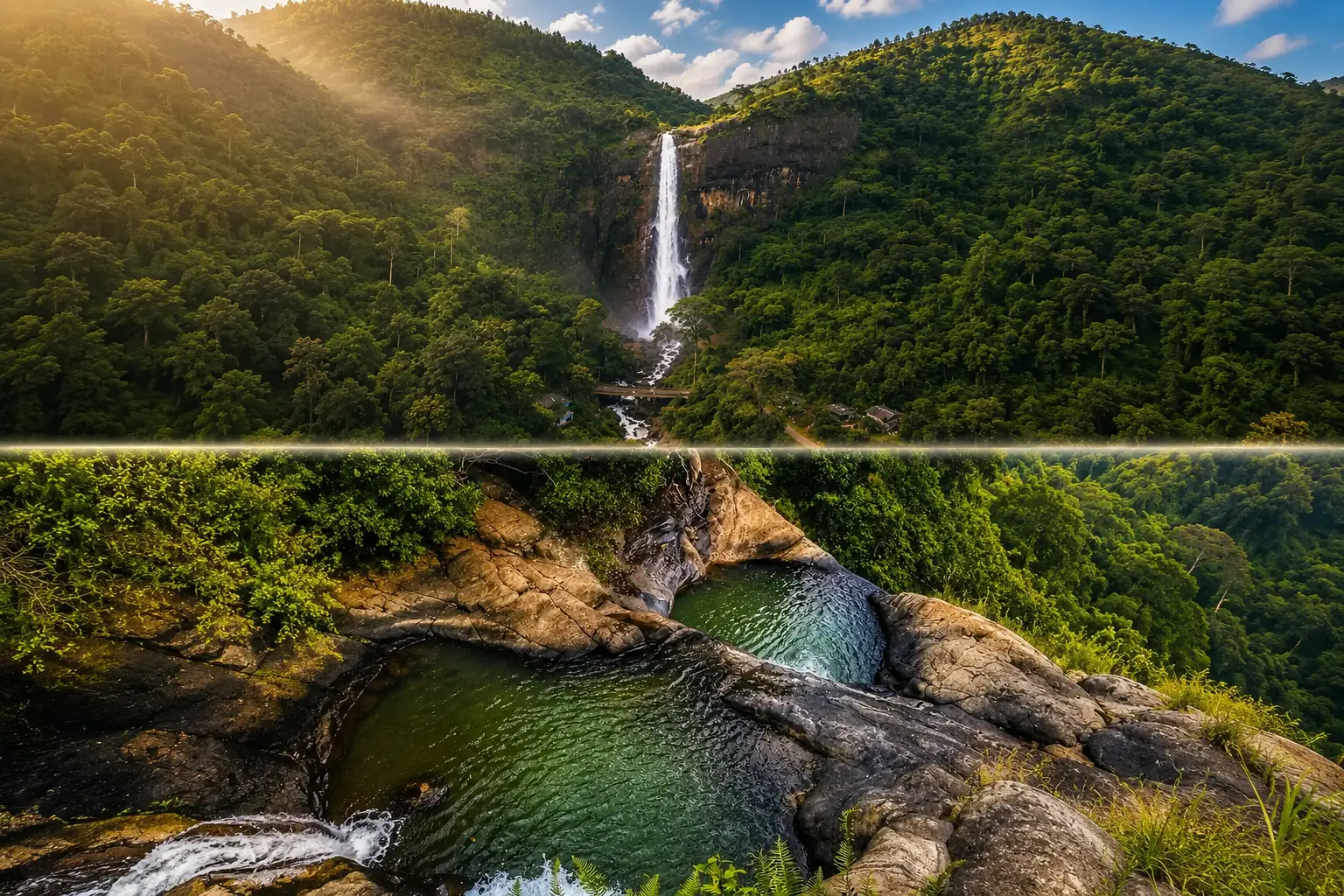
Diyaluma Falls drops 220 meters in a single plunge. That makes it the second-tallest waterfall in Sri Lanka. The full drop is what’s seen from the road below — this is called the lower falls.
At the very top of that same drop, natural pools have been carved into the rock. These pools are fed by the river before it spills over the edge. This area is called the upper falls, and it’s reached only by hiking.
So it isn’t two separate waterfalls. It’s one waterfall, viewed from two very different vantage points.
The Lower Falls: What’s Offered
The lower falls are viewed from the Colombo–Badulla highway. No hike is required. A short stop is all that’s needed.

From this angle, the full height of the falls is taken in at once. Water is seen dropping the entire 220 meters, from top to bottom, in one uninterrupted view. It’s a dramatic sight, and it’s made even more dramatic during wetter months, when the water volume is higher.
A closer viewing spot is sometimes found near the base, a short walk from the road. Even so, this isn’t a hike in any real sense. It’s more of a stroll.
What’s gained here:
- A quick, easy stop, requiring very little time
- The complete, dramatic view of the falls, seen from bottom to top
- Access for travelers who aren’t up for hiking — kids, older relatives, or anyone short on time
- No special gear or preparation needed
What’s missed here:
- No swimming is possible from this vantage point
- The famous infinity pools aren’t seen up close
- The valley views from the top aren’t experienced
Read more about “Lower Diyaluma Waterfall: The Complete Guide.“
The Upper Falls: What’s Offered
The upper falls are reached by a hike. Depending on fitness and pace, this hike takes between twenty minutes and an hour. The trail starts near the base and climbs steadily, crossing grassland before turning rockier near the top.

Once the top is reached, a different world is found. Natural pools, carved by years of flowing water, sit right at the cliff’s edge. Some pools are deep enough for swimming. Others are shallower, better suited for wading or simply sitting with feet in the water.
Beyond the pools, the view stretches out across the valley. It’s wide, open, and largely uninterrupted — the kind of view that’s hard to photograph fully, because no single frame captures it.
What’s gained here:
- Swimming, when conditions allow it
- Panoramic valley views, unavailable from the road
- The pools themselves, often described as the highlight of the entire visit
- A sense of accomplishment, earned through the hike
What’s missed here:
- Time. A proper visit to the upper falls takes at least a few hours, once travel and the hike are factored in
- Ease. The trail isn’t technical, but it does involve real effort, uneven ground, and sun exposure
- Certainty. Swimming isn’t always possible. It depends on the season and current conditions
Read more about “Upper Diyaluma Waterfall: The Complete Guide“
A Side-by-Side Comparison
| Lower Falls | Upper Falls | |
|---|---|---|
| Hiking required | None | Yes, 20 minutes to 1 hour |
| Time needed | 10–15 minutes | Half a day, including travel |
| Swimming possible | No | Yes, when conditions allow |
| View offered | Full-height view of the falls | Valley views from the top |
| Physical effort | Minimal | Moderate |
| Entrance fee | Free | LKR 350 per person |
| Best suited for | Short stops, families, limited time | Travelers wanting the full experience |

Which One Should Be Visited?
This depends entirely on what’s wanted from the visit, and how much time is available.
If time is limited, the lower falls are recommended. A short stop is made. A dramatic view is captured. Very little effort is required, and the visit fits easily into a longer day of travel between other destinations.
If a fuller experience is wanted, the upper falls are worth the effort. Swimming, valley views, and the full atmosphere of the pools can’t be replaced by the roadside view alone. A hike is required, but for most visitors, it’s considered worth it.
If both are wanted, it’s possible to visit both in a single day. A stop at the lower falls can be made first, followed by the hike to the upper pools, if energy and time allow. Many travelers choose this option, since the two views complement each other rather than compete.
Things Worth Knowing Before a Choice Is Made
A few extra details tend to shape this decision.
Fitness level matters. The hike to the upper falls isn’t extreme, but it isn’t flat either. Loose rock is encountered near the top. Some scrambling is involved. Travelers with mobility concerns, or those simply not wanting the exertion, may prefer the lower falls instead.
Season matters, too. During the dry season, the upper pools are generally safer for swimming. During the rainy season — roughly September through early December — water levels rise, currents strengthen, and swimming becomes far riskier. In this case, even a hike to the top may be treated as a scenic walk rather than a swim.
Group needs should be considered. A family with young children, or a group with mixed fitness levels, might be better served by the lower falls, or by splitting up — some hiking to the top, others staying below.
Time of day plays a role. Mornings are cooler, and the hike to the upper falls is more comfortable when the heat hasn’t fully set in. If the upper falls are chosen, an early start is recommended.
Getting to Each Viewpoint
Getting to the lower falls is simple. A tuk-tuk, private car, or even a public bus can be used. The falls sit right along the highway, so a driver is simply asked to stop. No advance planning is needed.
Getting to the upper falls takes a little more coordination. Transport is still needed to reach the trailhead, usually from Ella or a nearby town. From there, the hike itself begins. A guide isn’t required, but one can be helpful, especially for pointing out which pools are currently safe.

Most visitors base themselves in Ella. It’s the closest hub with accommodation and easy transport options. From Ella, both the lower and upper falls are within reach in a single day, if that’s the plan.
What a Typical Visit Looks Like
A visit to the lower falls is short. A driver is hired, or a bus is caught. The falls are viewed from the roadside. Photos are taken. The stop is over within fifteen minutes, and the journey continues.
A visit to the upper falls looks different. Time is set aside — usually half a day, once travel and the hike are included. The hike itself takes twenty minutes to an hour. Time is then spent at the top, swimming, resting, or simply taking in the view. The descent takes roughly as long as the climb, sometimes longer, since fatigue tends to slow the pace.
Neither visit needs to be rushed. But the upper falls, by nature, ask for more patience and more planning.
Cost Differences
The lower falls remain free to visit. Viewing the main drop from the base, along the A4 highway, costs nothing. Transport is the only real expense here, and even that can be minimal if the stop is combined with travel already planned between destinations.
The upper falls work differently. An entrance fee is charged for the hike and the natural pools. Local visitors pay LKR 350 per person. Foreign visitors pay more — typically USD 16 to 20 per adult, a rate that generally includes a guide fee. A ticket booth is found along the concrete walkway, partway up toward the top of the trail.
This fee is worth factoring into the decision. For a family or small group, the cost of visiting the upper falls adds up faster than the lower falls ever will. It’s still modest by most travel standards, but it’s no longer a “free” stop the way the roadside view is.
Overall, the upper falls now come with both a time cost and a small financial one. The lower falls remain the lighter option on both counts.
Why Some Travelers Regret Skipping the Hike
It’s worth being honest here. Some travelers, pressed for time, choose only the lower falls. Later, once photos are seen online, or once friends describe the pools at the top, a bit of regret is sometimes felt.
This isn’t universal. Plenty of travelers are perfectly satisfied with the roadside view alone. But if flexibility exists in the schedule, even an hour or two extra, the hike is often recommended — if only to avoid that lingering “what if” afterward.
Why Some Travelers Are Glad They Skipped It
The opposite is also true. Some travelers, especially those traveling with young children, older relatives, or anyone uncomfortable with heights or uneven terrain, are glad the lower falls were chosen instead. No one was pushed beyond their comfort level. The trip continued smoothly, without exhaustion or unnecessary risk.
There’s no single right choice here. What matters is honesty about the group’s needs, energy, and comfort with a bit of physical effort.
Neither view carries much risk. The upper falls, however, deserve extra caution.
No barriers are found at the top. The pools sit close to the edge, and there’s a long drop just beyond them. Photos should be taken carefully, and edges should be avoided. Swimming should only be attempted when conditions are confirmed safe, ideally by asking a local guide or driver on the day of the visit.

The lower falls, by comparison, are viewed from a safe distance. Less caution is needed here, though normal care around any roadside stop is still advised.
Final Thoughts
Neither the upper nor the lower falls is objectively “better.” They’re different experiences, shaped by different amounts of time, effort, and reward.
The lower falls offer a fast, easy, and still genuinely impressive view. The upper falls offer something deeper — a hike, a swim, and a view that’s hard to forget. When time allows, both are recommended. When it doesn’t, the choice should be made based on what matters most: convenience, or the fuller reward that comes with a bit of effort.
Either way, Diyaluma Falls is rarely called a disappointment. It’s one of those places where even the easier option leaves a lasting impression.


